Private Car Tour Hong Kong: A Family Reunion Day

When a family flies in from different places to be together, the trip needs to be easy. This group of 17 wanted to see the must-see sights of Hong Kong and find a few hidden gems that only a local would know. They also wanted to stay together all day. A private car tour was the right fit.

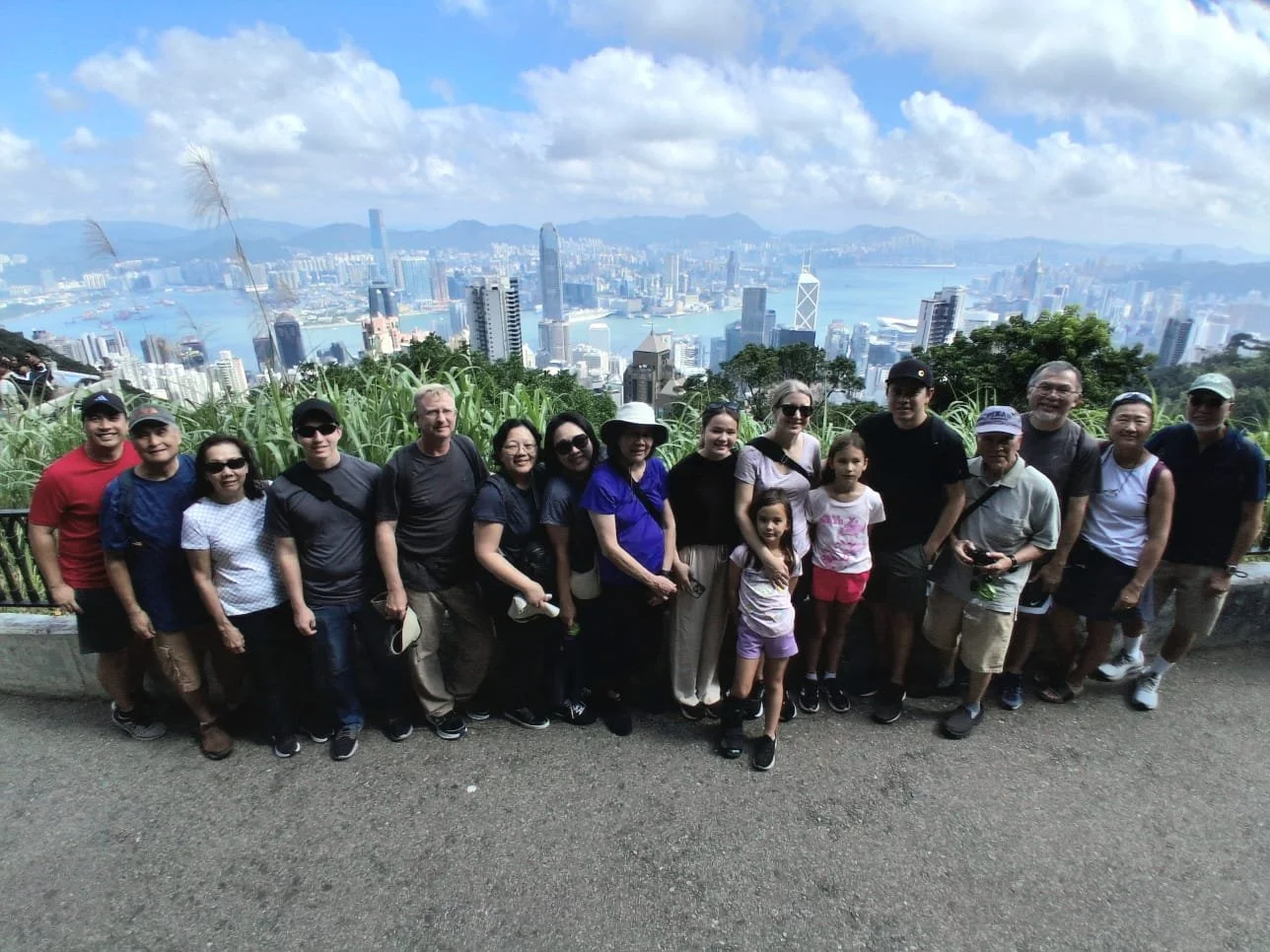
Family reunion group at Victoria Peak on a Hong Kong private car tour

They booked an 8-hour private tour with a comfortable 28-seater coach, so grandparents, parents, and kids could ride together and share the day. Their Hello Hong Kong tour guide was Mel, who kept the pace relaxed and the stops well planned.

Starting at Victoria Peak

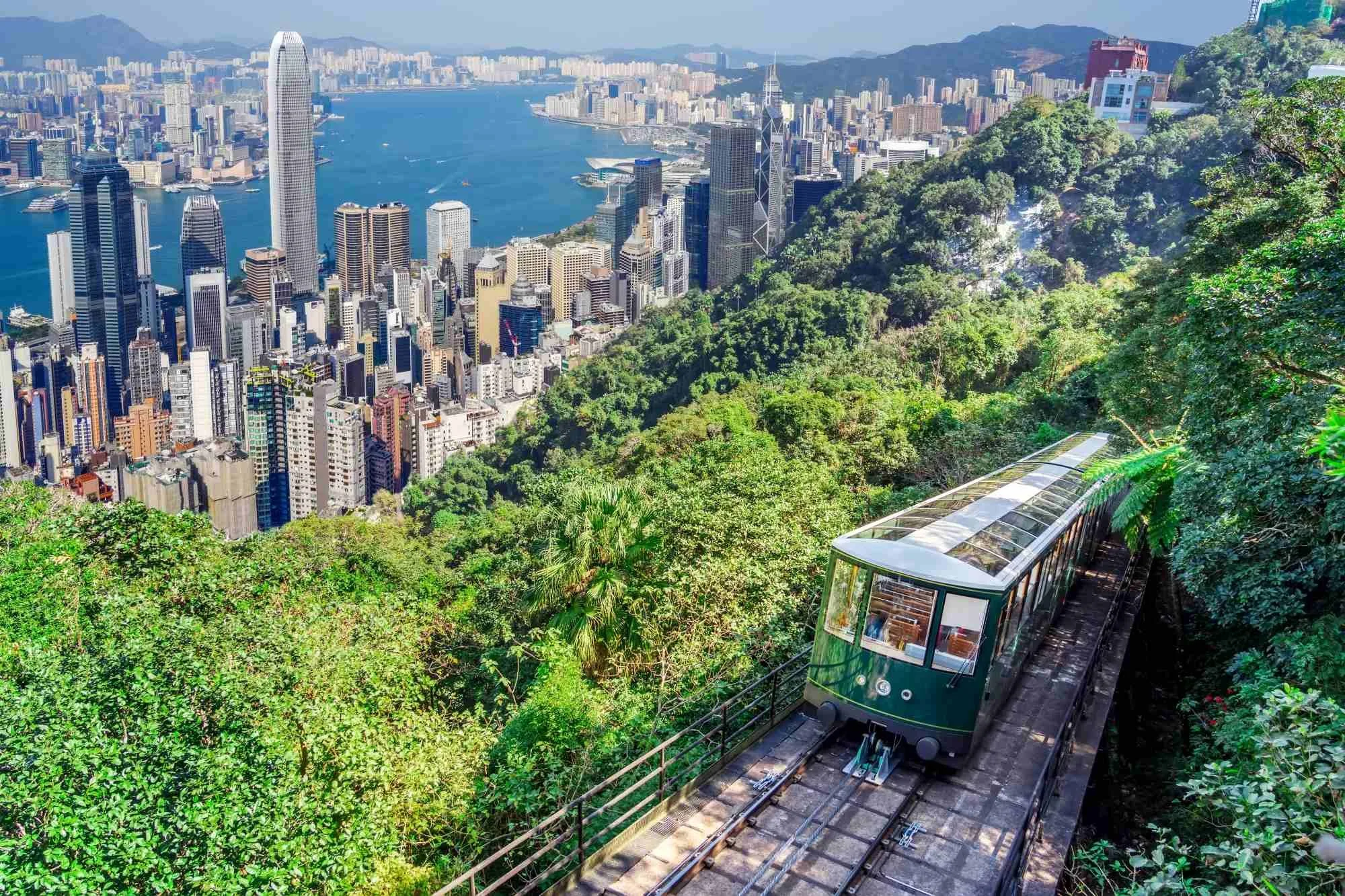
First-time visitors usually picture Hong Kong as tall buildings and busy streets. The view from Victoria Peak shows more. At about 552 metres above sea level, the Peak lets you see the harbour, the skyscrapers, and the green hills in one view. It was one of the group’s requested stops, and the whole family squeezed into one big photo with the skyline behind them.

Hidden Gems Beyond the Postcards

Every big city has a postcard side and a local side. A good private car tour mixes both. With Mel, the group could skip the crowds and visit places where daily life in Hong Kong is easy to see.

One stop was Cheung Sha Wan in Kowloon. Today it is known for fabric and fashion wholesale shops, and it feels very different from the tourist areas of Central. The group stopped for a classic Hong Kong egg tart. It is a good example of Hong Kong’s mixed food culture. The tart came from English custard tarts, but local bakers made it their own, with a smooth, shiny custard and flaky pastry. It is different from the Portuguese-style tart you find in nearby Macau.

A reunion trip is also a lovely time to revisit childhood places. Going back to a neighbourhood you knew long ago, even for a short stop and a snack, can make a trip feel much more personal.

Why a Private Car Tour Works for Big Families

  • Everyone stays together. No splitting into taxis.

  • Easy for all ages. A private coach means fewer long walks and more rest.

  • Flexible stops. Add a snack stop, a photo stop, or a place that matters to your family.

  • Local knowledge. A guide like Mel shares the history and culture behind each place.

Plan Your Own Family Trip

Travelling with a big group or several generations? We can build a private car tour around your family’s wishes, from famous sights to quiet corners with a story. Message Hello Hong Kong to start planning.

Hello Hong KongHello! Tours
Central Hong Kong Tour: An In-Depth Customised Walk

Central is the part of Hong Kong most visitors see first, and often understand least. From the street, it looks like glass towers, busy crossings, and people in a hurry. Look closer and you will find a police station turned arts centre, a market that has fed the city for generations, and buildings designed around ancient beliefs about luck and energy.

On a customised tour with Hello! Hong Kong Tours, you can slow down and see all of it. You can take a quick one-hour overview, or settle in for a full 2.5 hours. Here is what an in-depth exploration looks like.

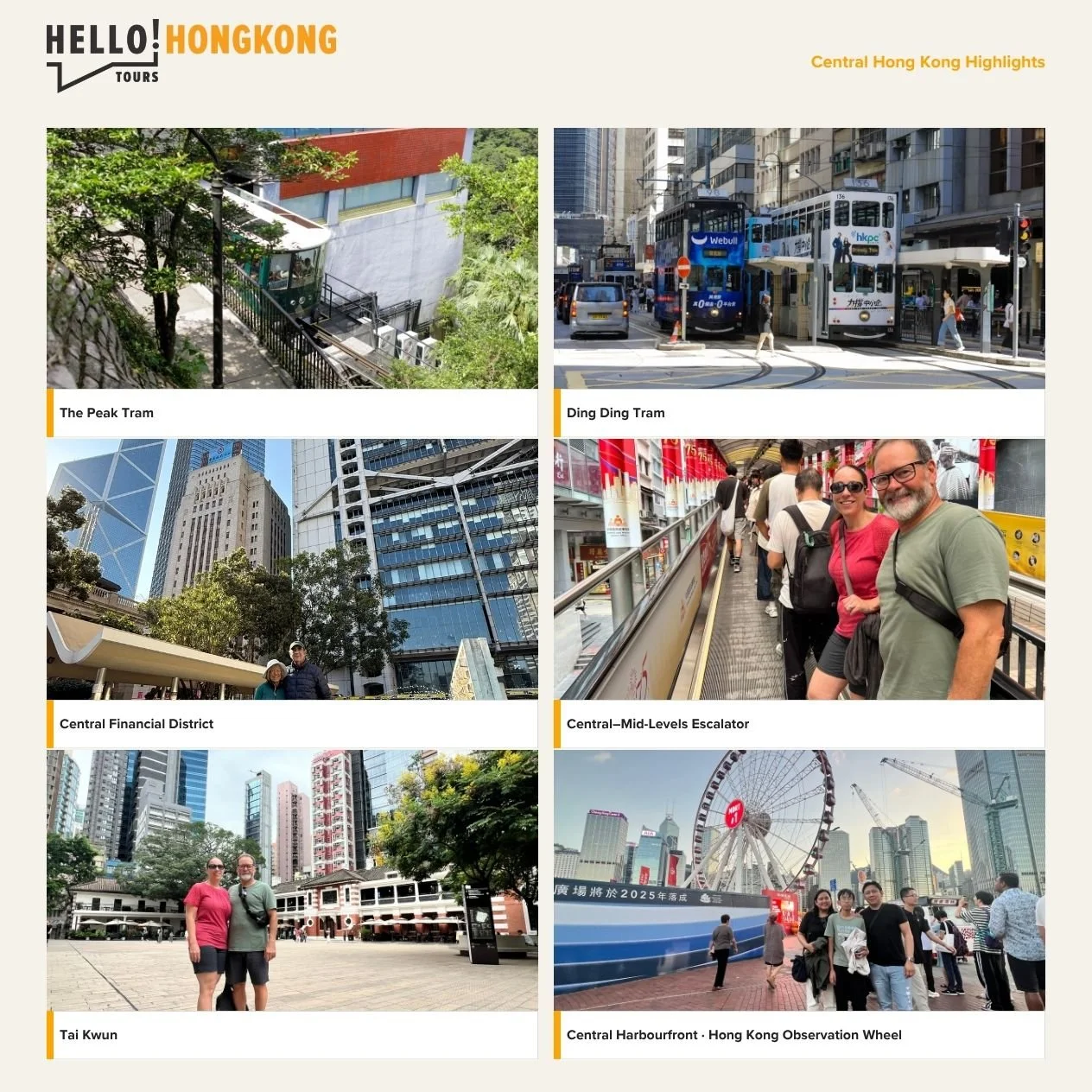
Central Hong Kong highlights on a customised tour with Hello! Hong Kong Tours.

Tai Kwun: From Police Station to Cultural Landmark

Your journey begins at Tai Kwun, a restored heritage site in the middle of Central. For over a century, this was the home of law and order in colonial Hong Kong. Today it is an arts and heritage centre, and its restoration won a UNESCO Cultural Heritage Conservation award.

The site holds three declared monuments:

  • The former Central Police Station, where officers once worked and lived.

  • The Central Magistracy, where cases were heard and decided.

  • Victoria Prison, which held prisoners for well over a century, until it closed in the 2000s.

Walking between these buildings, you can see how justice worked in early Hong Kong, from arrest to trial to imprisonment. It feels a little like visiting an old European courthouse and fort in one place, except the courtyards now host galleries, cafés, and open-air events. Plan for a slow walk here. There is much to read and see.

The Central–Mid-Levels Escalator

Next, you will ride the Central–Mid-Levels escalator, the longest outdoor covered escalator system in the world. It climbs the steep hillside in a series of connected stages, passing shops, restaurants, and homes along the way.

It was built to help people travel between the busy business district below and the residential streets above. In the morning the escalator runs downhill for commuters, and later in the day it runs uphill. It is part of daily life here, so you will ride alongside locals heading to work or home. Think of it as a moving street where you can watch the neighbourhood pass by at eye level.

Banking, Business, and Feng Shui

Central is one of the world’s major financial centres, and its skyline tells a story. As you walk through the banking district, you will learn how feng shui shapes architecture and business here.

Feng shui is the traditional Chinese practice of arranging space to bring balance and good fortune. In Hong Kong, many companies still consult feng shui masters before choosing a building’s shape, entrance, or position. You may notice the way some towers face the harbour, how entrances are placed, and why some designs avoid sharp angles pointing at other buildings. Once you know what to look for, the skyline reads like a code.

City Views at the Hong Kong Monetary Authority

From the Hong Kong Monetary Authority (HKMA) building, you can enjoy a wide view across the city and harbour. It is a good moment to pause and see how mountains, towers, and water fit together.

Here you will also learn something many visitors find surprising: how Hong Kong issues its bank notes. Unlike in many places, where a central bank prints the currency, Hong Kong’s notes are issued by a small group of commercial banks, under the supervision of the HKMA. Look at the notes in your wallet afterward and you will see the differences between them.

Graham Street Wet Market

After the towers, you will step into a very different Central. Graham Street market is one of the oldest continuously operating produce markets in Hong Kong. Stalls spill down the slope, piled with vegetables, fruit, fish, and meat.

A “wet market” gets its name from the water used to keep produce fresh and the floors clean. Many Hong Kong families still shop here daily, choosing ingredients for that night’s dinner. If you are used to supermarkets, this will feel lively and close up. Expect noise, colour, and quick conversations between vendors and regulars. It is one of the best places to see everyday Hong Kong life.

A Ride on the “Ding Ding” Tram

Next, you will cruise through the district on a tram, which locals call the “ding ding” after its warning bell. These double-decker trams have been part of Hong Kong’s streets for over a century. The ride is included in your tour price.

Try to sit upstairs by the front window. You will pass shopfronts, signs, and office workers, all at a gentle pace. It is slow, cheap, and one of the most charming ways to see the city.

The Star Ferry to Tsim Sha Tsui

Your tour ends with a classic Hong Kong crossing: the Star Ferry from Central to Tsim Sha Tsui. The ferry ride is also included in your tour price.

The Star Ferry has carried passengers across Victoria Harbour since the late 1800s. The trip takes only about ten minutes, but the view is wonderful. You will see the skyline you just explored rise behind you, with the harbour in front. It is a fitting way to finish, and many travellers call it a highlight of their whole trip.

Choose the Tour That Fits Your Time

  • 1 hour: A short overview, ideal if you want the main highlights.

  • 2.5 hours: An in-depth exploration, with time to learn the stories behind each stop.

Because the tour is customised, we can adjust the pace, focus on what interests you most, and match the walk to your group.

Ready to Explore Central?

Central rewards curious visitors. With a local guide, the towers, markets, and monuments become a connected story about how Hong Kong grew. Contact Hello! Hong Kong Tours to plan your own customised Central tour.

Hello Hong KongHello! Tours
Sharp Island (Kiu Tsui Chau): 7 Things to Do in One Day

Looking for a quick island escape without leaving Hong Kong? Sharp Island, or Kiu Tsui Chau (橋咀洲), sits just off Sai Kung and is only about 15 minutes away by boat.

This small volcanic island is part of Kiu Tsui Country Park and the Hong Kong UNESCO Global Geopark. Here's how to get there and 7 things to fill one perfect day.

7 Things to Do on Sharp Island in One Day

1. Walk the Tombolo to Kiu Tau:

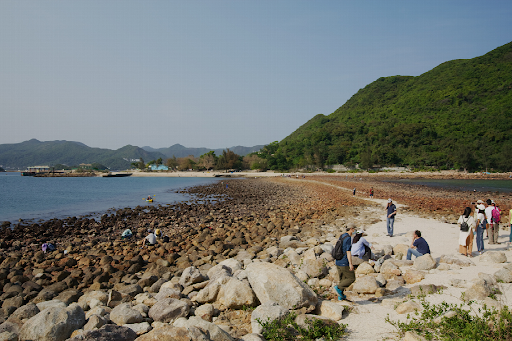
At low tide, a sandbar of about 200 metres rises from the sea and links Sharp Island to the small islet of Kiu Tau. Walking across feels like finding a secret path, but check the tide times first, because the path disappears under water when the tide comes back in.

2. Spot the Pineapple Bun Rocks:

Along the shore, look out for the volcanic boulders with cracked, crusty surfaces that locals compare to Hong Kong's famous pineapple bun. These rocks formed around 140 million years ago, and they make Sharp Island one of the easiest geopark sights to reach from the city.

3. Relax on a Sharp Island Beach:

Hap Mun Bay, also called Half Moon Bay, is the beach most visitors fall for: a soft crescent of sand with barbecue pits, showers, changing rooms and lifeguards in the swimming season. If you'd rather swim as soon as you land, Kiu Tsui Beach sits right by the main pier, and its long stretch of calm water is perfect after the boat ride.

4. Learn About Sharp Island Coral Protection:

Sharp Island has some of the richest coral in Hong Kong, and crowds have damaged it in the past. Since May 2026, buoys mark shallow coral zones as no-entry areas, and WWF-Hong Kong staff and Ocean Ambassadors share tips with visitors on public holidays from May to October. The government also plans to turn about 63 hectares around the island into a marine park, with the legal steps targeted for mid-2027.

5. Snorkel the Clear Water:

The clear water around the island is great for snorkelling, as long as you enter and exit from sandy spots, never stand on coral and leave every shell and crab where you found it. Loved what you saw? Many snorkellers go on to learn scuba in warmer water, and Chinese-speaking readers can start by comparing 印尼 PADI 课程 for their first certification.

6. Hike Across the Island:

For the best views, follow the trail of about 2 kilometres that links Kiu Tsui with Hap Mun Bay and passes the lookout at Hak Shan Teng. Allow one to two hours, and start at Kiu Tsui so you can finish at Hap Mun Bay and catch your boat back from there if your ticket allows it.

7. End With Seafood in Sai Kung:

Back on the mainland, stroll along the Sai Kung waterfront and pick your dinner straight from the seafood tanks. It's the perfect way to wrap up a sunny day on the water.

How to Go to Sharp Island

Getting to Sharp Island is easy, but it takes two steps:

Step 1, get to Sai Kung:

  • Take the MTR to Choi Hung station, then hop on green minibus 1A to Sai Kung town, about 20 to 30 minutes.

  • Prefer the bus? Route 92 and route 299X also end at Sai Kung Bus Terminus, a short walk from the pier.

Step 2, take a kaito from Sai Kung Public Pier:

  • Small kaito boats leave from the pier to Sharp Island Pier (Kiu Tsui) and Hap Mun Bay. The ride takes about 15 minutes.

  • Return tickets usually cost around HK30toHK40 and are sold at kiosks on the pier, often cash only. Boats leave every 15 to 30 minutes once they fill up.

Good to know:

  • Each operator runs its own schedule, so ask for the last boat back before you leave.

  • On public holidays the island gets very busy, so a weekday visit is much more relaxing.

Final Thoughts

Sharp Island proves you don't need a long flight to find sandy beaches, ancient rocks and colourful coral. Plan around the tides, travel light and treat the reef with care, and one day here will feel like a real holiday.

And if your day by the sea sparks a bigger dream, you could even end up teaching others to dive. Chinese-speaking divers who want to go pro can look into the 印尼 PADI 教练发展课程 (IDC), the course that trains new PADI instructors.

Learn More

How long is the boat ride to Sharp Island?

The kaito from Sai Kung Public Pier takes about 15 minutes.

Can you swim at Sharp Island?

Yes. Hap Mun Bay and Kiu Tsui Beach are both popular for swimming, and Hap Mun Bay has lifeguards in the swimming season. Stay out of the shallow coral zones marked by buoys.

When can you walk the tombolo?

Only at low tide. Check the tide predictions from the Hong Kong Observatory before your trip, and head back early so you don't get stranded on Kiu Tau.

Is Sharp Island good for kids?

Yes, the short boat ride and calm beaches make it an easy family day out. Just keep a close eye on children near the water and on the tombolo.

Can I take shells or crabs home?

No, please leave everything where you found it. Officials have reminded visitors not to remove crabs, shells or other marine life from the island.

Is there food on the island?

Options on the island are limited, so bring enough water and snacks for the day. For a proper meal, save your appetite for the seafood restaurants in Sai Kung town.


Hello Hong Kong
Hong Kong To Do List: A Food Lover’s Autumn Guide

Autumn is one of the best times to eat in Hong Kong. The heat fades, the air feels lighter, and menus change with the season. If food is on your Hong Kong to do list, this Hong Kong guide covers three autumn favorites and where to find them.

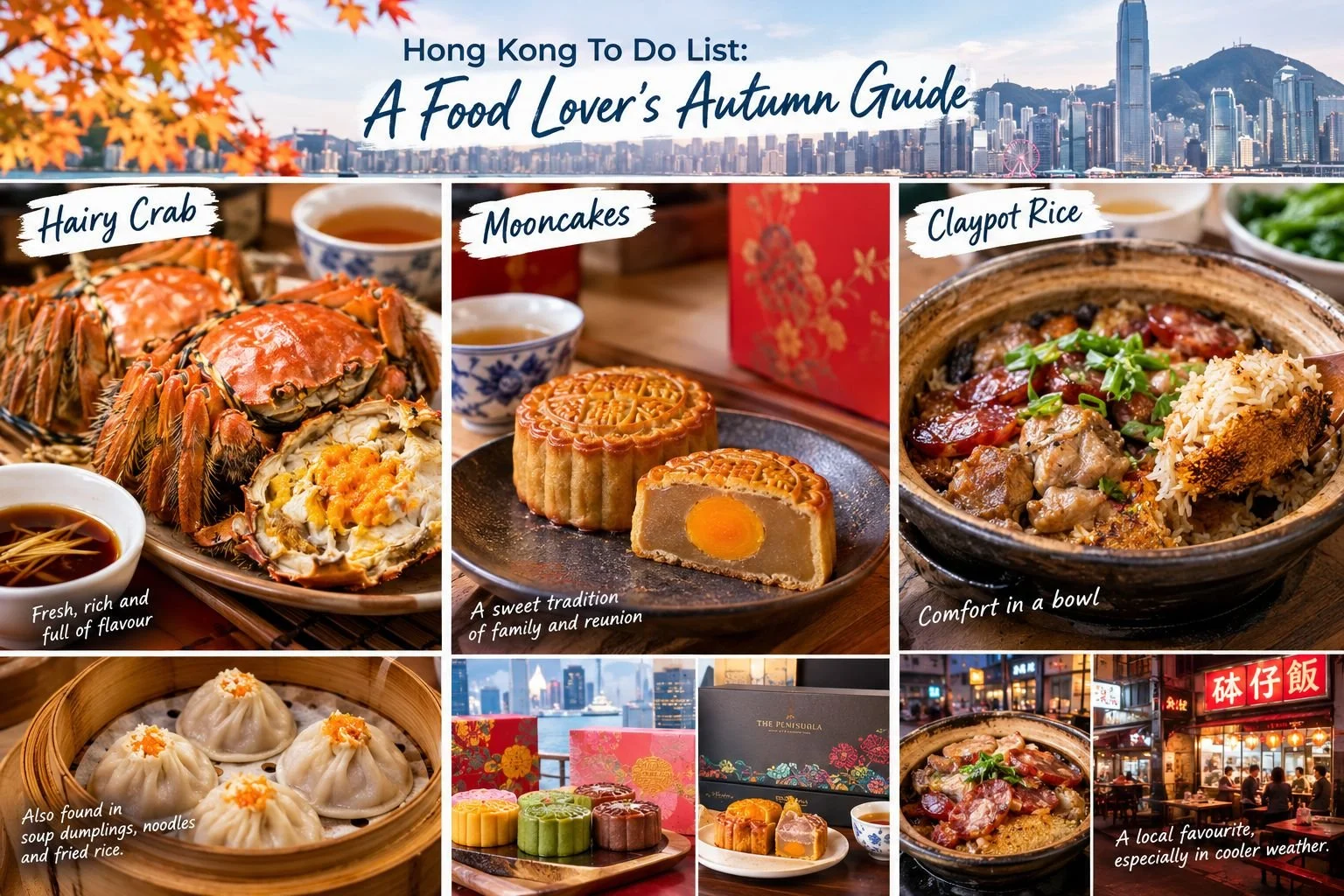
Image for illustrative purposes only. Actual dishes and presentation may vary.

Hairy Crab: The Taste of the Season

Hairy crab is the star of autumn. It is named for the fine hair on its claws, and it is best from about October to December. Most are raised in Yangcheng Lake, near Shanghai. Many locals wait all year for the first crabs to arrive.

The prize is the roe and the rich, creamy crab fat. Chefs often steam the crab whole and serve it with ginger vinegar and warm ginger tea. In Chinese food culture, crab is a “cooling” food, so the ginger balances it. You may also see it in soup dumplings, noodles, and fried rice.

Where to try it: Shanghainese restaurants are a good place to start. Wu Kong Shanghai Restaurant in Tsim Sha Tsui is a well-known option. Many Cantonese restaurants and hotel dining rooms also add hairy crab menus in autumn. Prices change with the size of the crab, so ask before you order.

Mooncakes: A Sweet Tradition

Mooncakes are linked to the Mid-Autumn Festival, which honors the full moon and family reunions. The classic one is a round, dense pastry filled with lotus seed paste and a salted egg yolk. The yolk looks like the moon. Families cut a mooncake into small wedges and share it with tea.

Think of it like fruitcake at Christmas in the West. It is a seasonal gift, and people often love it or tease it. Modern bakers now make snow skin, custard, and even ice cream versions.

Where to try it: Wing Wah Cake Shop, Kee Wah Bakery, and Maxim’s are local favorites. Hotels such as The Peninsula also make fancy boxes. The festival has already passed this year, so stock may be limited. Some shops keep selling for a while, but go early.

Claypot Rice: Comfort in a Bowl

When the weather cools, claypot rice is the dish many locals crave. Rice is cooked over charcoal or a strong flame in a clay pot. A crispy golden layer forms at the bottom. This is the best part, and locals fight for it. Toppings often include Chinese sausage, cured meat, chicken, or spare ribs. The server adds sweet soy sauce at the table, and you stir it all together.

Expect a wait. Each pot is cooked to order, usually 20 to 30 minutes. This is normal, and it is part of the experience. Order a side of greens and some hot tea while you wait.

Where to try it: Kwan Kee Clay Pot Rice in Sheung Wan is a popular choice. In Yau Ma Tei, look for claypot rice around the Temple Street area, where small restaurants fill the streets at night. Always check opening hours first, as many claypot places only open for dinner.

Tips for Your Autumn Food Trip

  • Book popular restaurants early, especially for hairy crab.

  • Go with a few people so you can share many dishes.

  • Bring a light jacket for the cooler evenings.

  • Ask your hotel or a local guide for current favorites, since menus and shops change.

Hong Kong in autumn is a feast for the senses. Add these three dishes to your Hong Kong to do list and you will taste the season the way locals do.

Hong Kong Travel Guide for First Timers: Three Days Beyond the Skyline

A good Hong Kong travel guide for first timers gives each day one district and one job. Markets in Kowloon. A ridge walk on Hong Kong Island. A seafood lunch on an outlying island.The harbor views can fit around these outings without taking over the three-day itinerary  Slow days suit this city better than packed ones, and the three below are built that way.

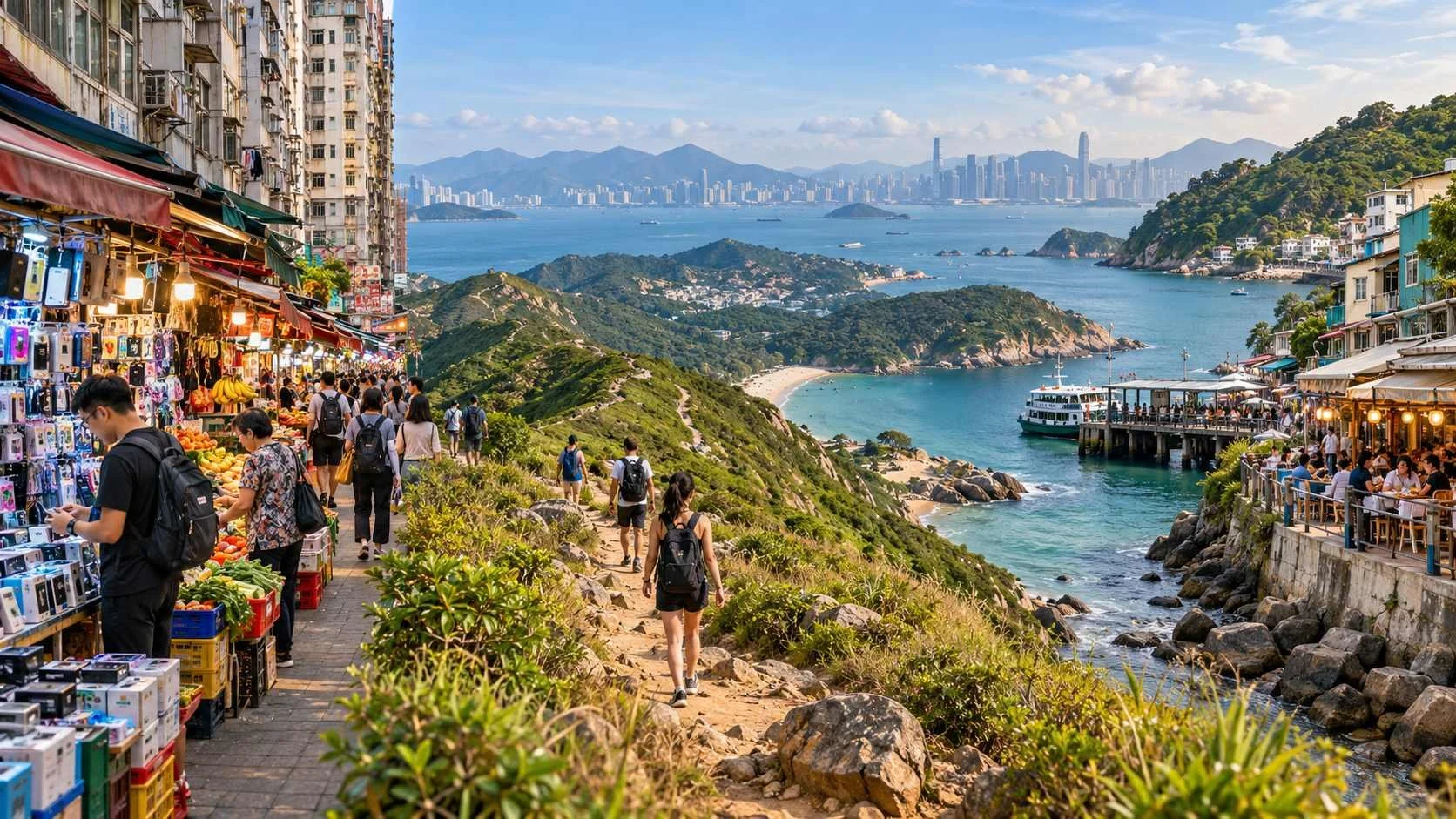
Illustration provided by our contributing author. Digitally generated image for illustrative purposes only.

Why One District per Day Works

‍‍‍ Build each day around one part of Hong Kong, then look for places worth visiting nearby. Sham Shui Po can fill a morning of browsing followed by lunch without another journey across town. Save Dragon’s Back for a day that allows for the trip to the trailhead and the walk itself. An island outing needs its own place in the schedule. Distances on the map do not account for station passages, ferry connections, or steep streets. Once the main visit is chosen, add a few stops within reach. Keep the rest open so a longer lunch or an interesting side street does not disrupt the day.

Keeping a Group Together in Crowded Streets

For companions already using Telegram, a search for Telegram 繁體中文 can help them explore Chinese interface options before sharing the market-day arrangements. One person stops for a snack, another follows the crowd, and nobody agrees where to meet. Pin the meeting point to the top. Telegram can also share live location, handy when someone vanishes behind a fruit stand. And if the app opens in English, the Telegram 中文設定指南 shows how to change the language.

Hong Kong Travel Guide to Sham Shui Po

Sham Shui Po fills the northwest corner of Kowloon, and the MTR drops you right in it. Any Hong Kong travel guide that stops at the harbor misses this part of the city entirely. The streets here are sorted by product, which saves a lot of wandering:

Street What it sells

Apliu Street New and second-hand electronics

Fuk Wing Street Toys, which explains the nickname Toy Street

Pei Ho Street Fresh produce and street stalls

Ki Lung Street Buttons

Yu Chau Street Beads

Nam Cheong Street Zips and ribbon

Apliu Street got its name from an old duck-raising village. Its stalls have fixed pitches for licensed vendors, so they don't pop up and vanish. For fabrics, visit Sham Shui Po Fabric Market at 269 Tung Chau Street, where the former Yen Chow Street bazaar relocated in 2023. Choose a lunch stop near the streets being explored, checking its menu and opening hours before adding it to the route. 

Two Ways to Leave the City: Dragon's Back and Lamma Island

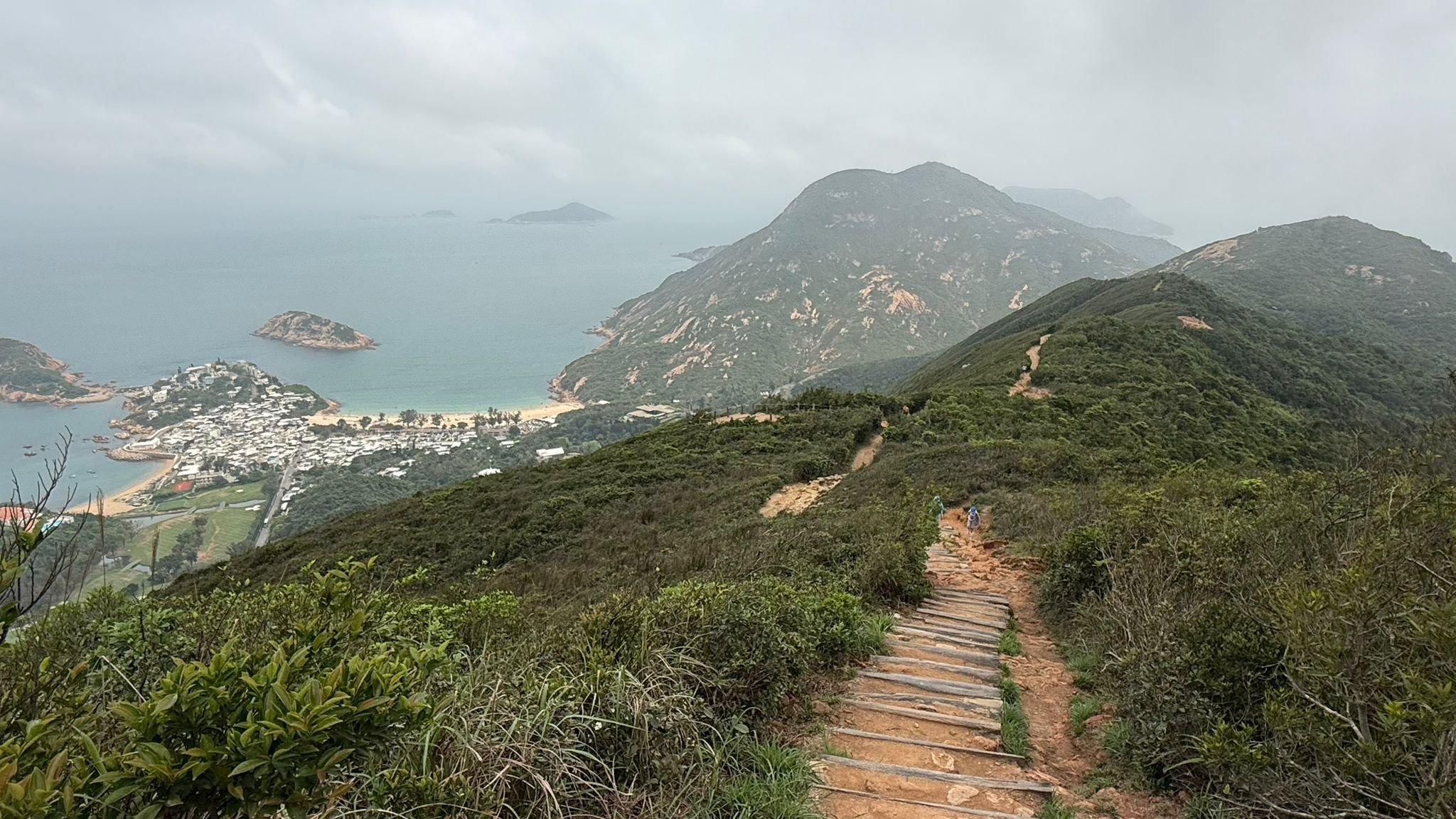
Dragon's​‍​‌‍​‍‌ Back, a beautiful ridge hike, is situated on Hong Kong Island. You can reach Shek O from Shau Kei Wan by bus or minibus and then catch the bus going to Shek O Road at To Tei Wan. From there, the footpath starts. A beautiful view of Tai Tam Bay and Tai Tam Harbour that you'll have on your journey up the cliff line is definitely a great highlight. You may still be looking at two peaks at the same time, Shek O and Wan Cham, in front of you as the landscape opens up more for your eyes. Based on the official hiking site, this path is only 4.8 km long, you'll only use 2.5 hours, and that is also the starting point of the Tai Tam Gap. There isn't much shade on the trail, so it is a great idea to bring along a ​‍​‌‍​‍‌hat.

Lamma‍‍‍ requires a boat to get around. ferries go to two destinations, Yung Shue Wan (around 15 minutes) and Sok Kwu Wan (about 40 minutes) via Central Pier 4. From Yung Shue Wan upwards the climb is steepest while the legs still have some fuel in. After that, the footpath will take you to Sok Kwu Wan where you shall return either by a boat or a footpath as the pier near the restaurant rows is very tiny. At village entry, a small Tin Hau temple indicates that food stalls are not more than a few steps ‍‍‍away.

Numbers need a warning, though. Guides don't agree on trail lengths:

  • Dragon's Back is 4.8 km on the official route and 7 to 8.5 km in guides that carry on to Shek O or Big Wave Bay.

  • The Lamma Family Trail gets quoted anywhere from 3 to 9 km, depending on the source and where the walk starts and ends.

  • Check where a walk starts and finishes. The headline distance alone says little.

Hong Kong Travel Guide Cheat Sheet


Place Getting there Distance or time Best for

Sham Shui Po MTR to Sham Shui Po station Walkable streets Markets and street food

Dragon's Back Bus or minibus 4.8 km/ 2.5 hours Ridge views

Lamma Island Ferry from Central Pier 4 30 minutes to Yung Shue Wan Island walk and seafood


Weather will probably rewrite the order, so rank the days like this:

  1. Sham Shui Po first. Markets work in any weather.

  2. Dragon's Back on the clearest day of the three.

  3. Lamma on whatever day is left, after checking the ferry timetable the night before.

Short Hong Kong travel guides work when the routes are real and the distances honest. Three days, one district each, an afternoon left empty. That's the whole Hong Kong travel guide, really.

Chung Yeung Festival Hong Kong: Hiking and Ancestor Visits

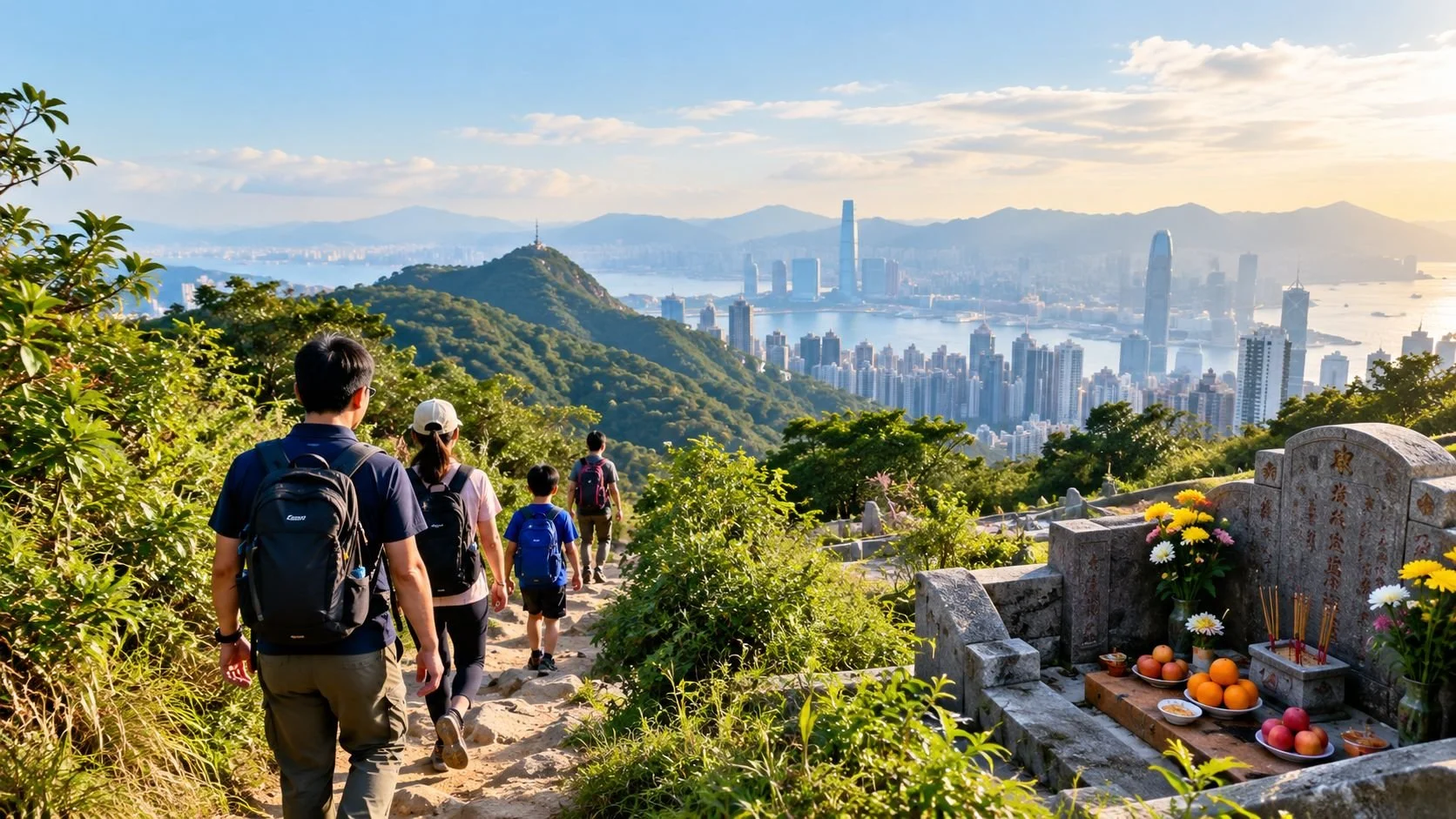
If you visit Hong Kong in autumn, you may notice something unusual. Trails fill up with families, and hillside cemeteries are busy with people carrying flowers and fruit. This is Chung Yeung, also called the Double Ninth Festival, and it is one of the most meaningful days of the local calendar.

Image generated using AI.

What Is Chung Yeung?

Chung Yeung falls on the ninth day of the ninth month of the lunar calendar, usually in October. In Chinese thought, nine is a “yang” number linked to strength and long life. Two nines together make a day of strong yang energy, which is why the festival is also tied to health and old age. In mainland China it is celebrated as Seniors’ Day.

The Legend Behind the Hills

The most famous story comes from the Han dynasty. A man named Huan Jing was warned by his teacher that disaster would strike his village on the ninth day of the ninth month. He was told to take his family to high ground and drink chrysanthemum wine. They did, and when they came home, all of their livestock had died. People believed the climb had saved their lives. Families have been going up hills on this day ever since.

Two Traditions in One Day

Today, Chung Yeung has two sides. One is outdoors: families hike, enjoy the cooler weather, and sip chrysanthemum tea, a flower long thought to help the body.

The other is quiet and personal. Chung Yeung is the second major time of year, after Ching Ming in spring, when families sweep the graves of their ancestors. They clean the tomb, lay out food such as roast pork, fruit, and rice, offer incense, and burn paper offerings. Think of it as something like Memorial Day or All Souls’ Day in the West, but combined with a family day out in nature.

What Visitors Should Expect

  • It is a public holiday. Trains, buses, and popular trails get busy, so start early.

  • Cemeteries are busy and sacred. If you pass one, be quiet and respectful, and avoid taking photos of families who are paying their respects.

  • The weather is lovely. Autumn is dry and mild, which makes it one of the best seasons for hiking. Still, bring water, sun protection, and good shoes.

Easy Hiking Spots for Visitors

Victoria Peak (Peak Circle Walk): A flat, paved loop of about an hour with wide views of the harbour and skyline. It is ideal for beginners and families.

Dragon’s Back: A famous ridge trail on Hong Kong Island with sea views and a finish near Shek O beach. It is moderate, and the best choice if you want a real hike.

Lantau Island (Ngong Ping area): Take the cable car up, visit the Big Buddha, then walk part of the Lantau Trail. Many people go on to climb Lantau Peak, but that one is steep and best for experienced hikers.

Lion Rock: A shorter but steep climb with a great view of Kowloon. It is better for confident walkers.

A Day That Shows the Real Hong Kong

Chung Yeung shows how a modern city still holds on to old values: respect for family, remembering those who came before, and enjoying nature together. If you are in Hong Kong around this time, a hike is a lovely way to take part, and to see the city from above, the way families have for nearly two thousand years.

3 Hong Kong Experiences Tourists Usually Miss

Victoria Peak, Star Ferry, Big Buddha — they're all worth doing, and they're on almost every Hong Kong to-do list for a reason. But after those, a lot of visitors run out of ideas and end up spending their remaining days shopping in the same two malls. Here are three experiences that don't always make the guidebooks, but genuinely deserve a spot in your itinerary.

1. A Wet Market Walk

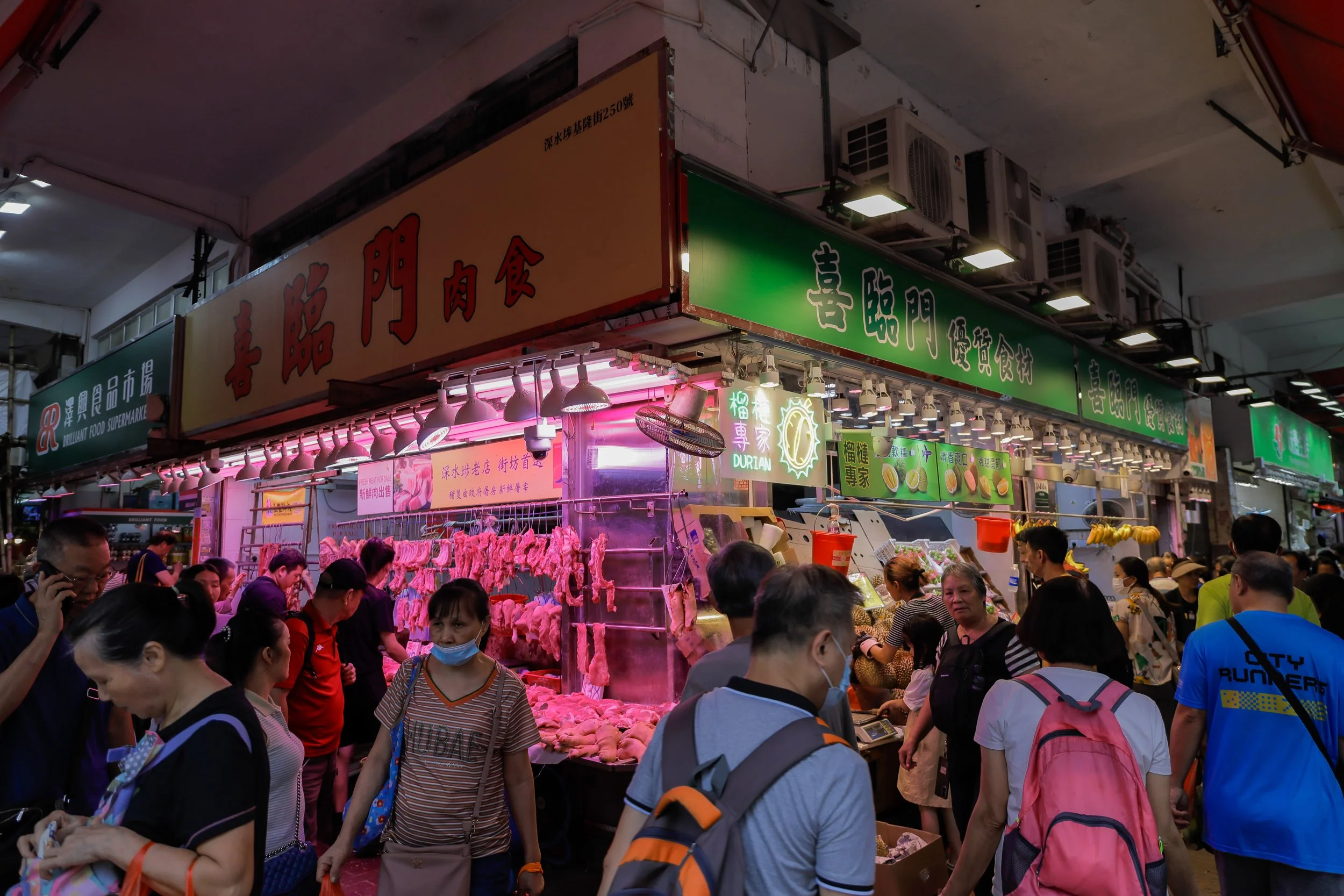
Hong Kong's wet markets are where the city actually shops for dinner — fresh produce, live seafood tanks, butchers, and dried goods stalls all crammed into narrow lanes. It's noisy, a little chaotic, and completely unlike the shopping malls tourists usually see. Markets like the one in Sham Shui Po or Kowloon City give you a real sense of daily life in Hong Kong, and they're a great warm-up if you're about to try cooking or eating local dishes.

2. Old Neighbourhood Temples

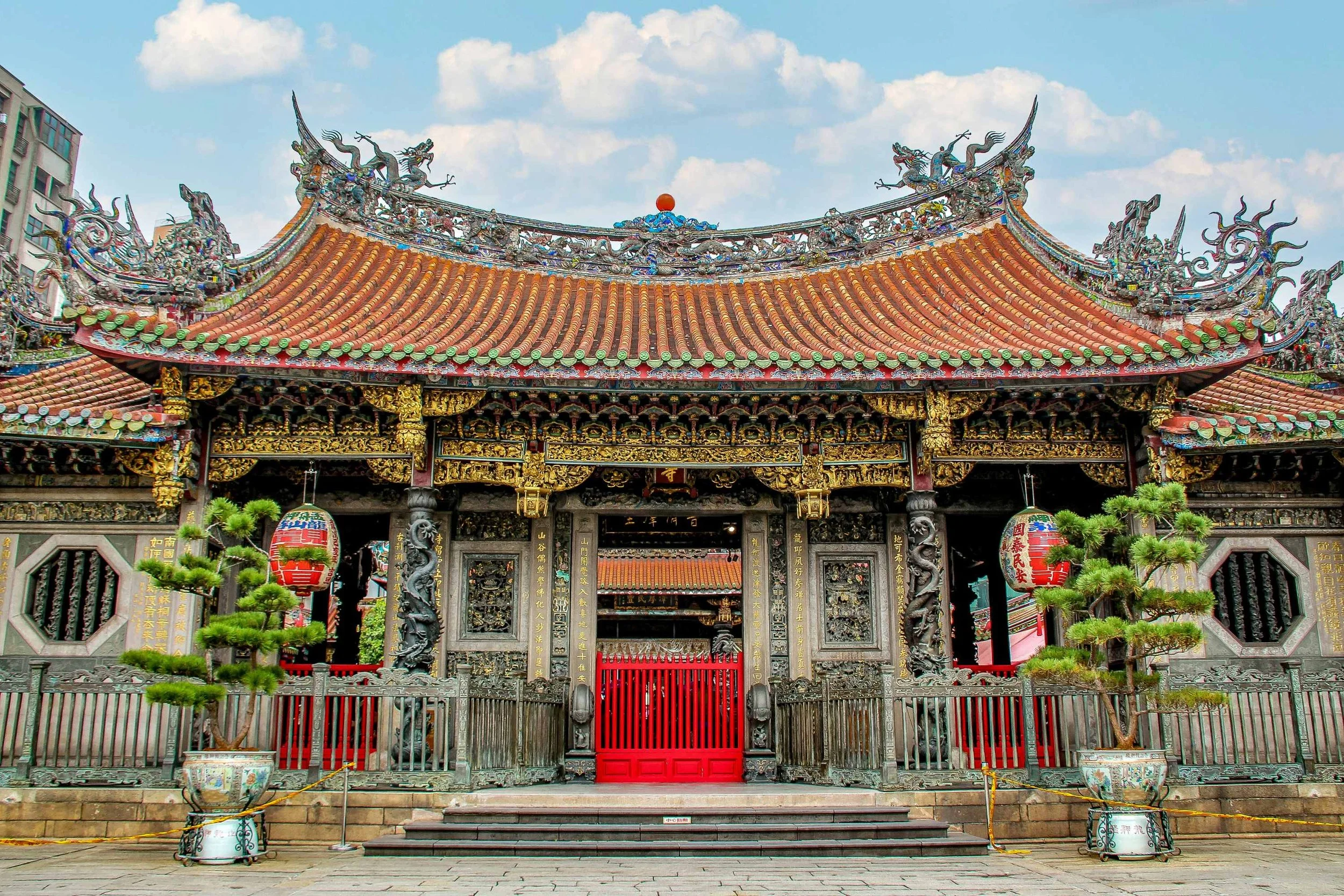
Everyone visits the big landmark temples, but Hong Kong has dozens of smaller neighbourhood temples tucked between apartment blocks, often still active with locals lighting incense on their way to work. Places like Man Mo Temple show the city's history as a trading port, when merchants prayed for safe journeys and good fortune. Slowing down to visit one of these gives you a quieter, more reflective side of Hong Kong that's easy to miss between shopping stops.

3. Hiking Trails With City Views

Hong Kong is surprisingly green — over 70% of its land is countryside, and there's an extensive network of hiking trails, many with skyline or harbour views you won't get from street level. Trails like Dragon's Back are manageable for most fitness levels and reward you with sweeping views over the coastline. September is actually a great time to try this, since the worst of the summer heat starts to ease while the trails stay lush.

Why These Matter

These three experiences share something in common: they show you Hong Kong as it actually is, not just how it's packaged for visitors. A market walk, a quiet temple, a trail with a view — small moments that end up being some of the most memorable parts of a trip.

If you want a day that blends a few of these local experiences instead of piecing them together yourself, message us on WhatsApp — we can build something around what you're already curious about.

Meet the Newest Faces of Hello! Hong Kong Tours

We're excited to introduce two new guides joining the Hello! Hong Kong Tours family — Robert and Raymond. Between them, they bring decades of local life, global perspective, and a shared love of showing guests the Hong Kong that guidebooks miss.

Robert: The Local Who's Seen It All

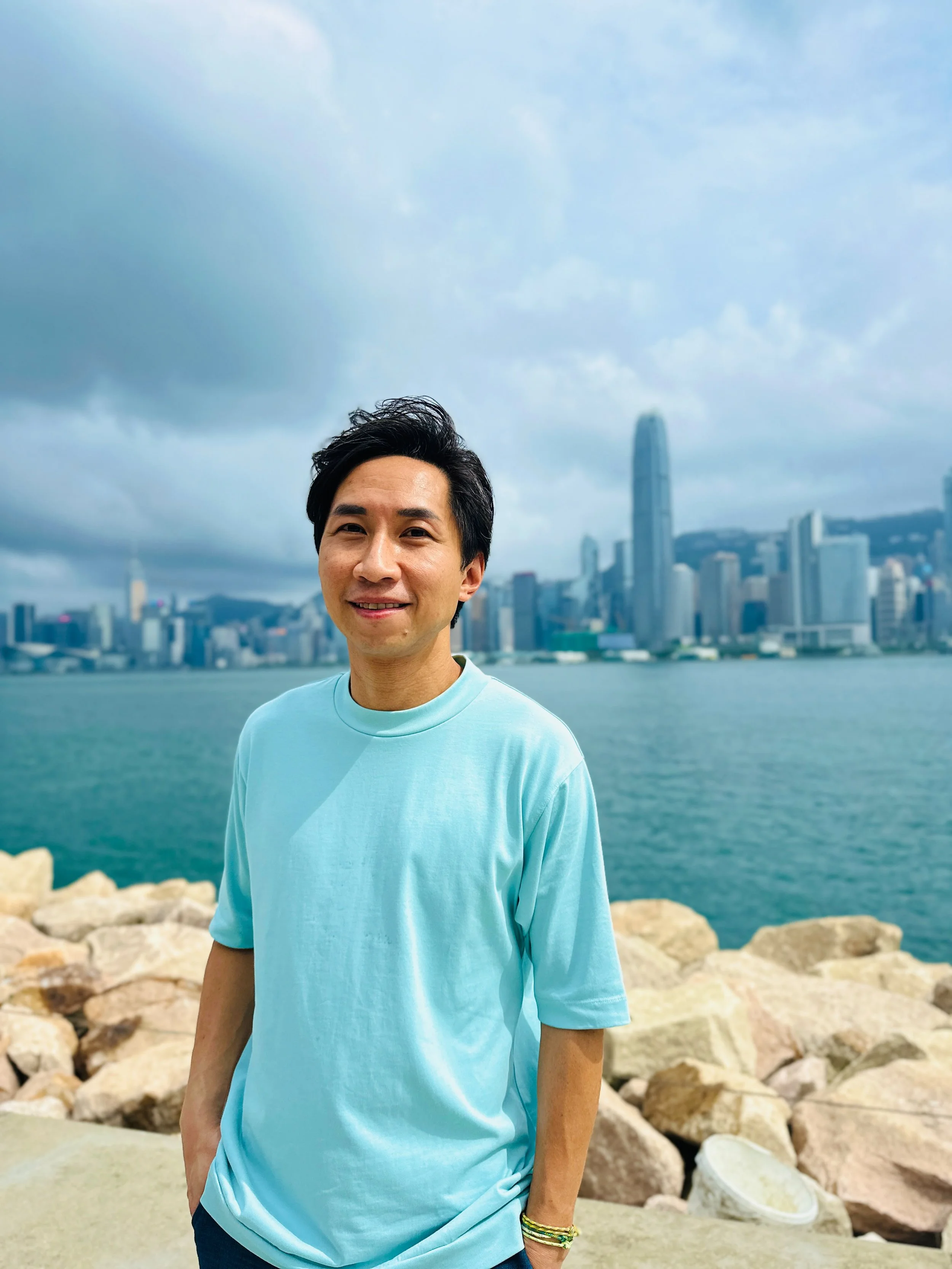
Robert, Hello! Hong Kong Tours guide, smiling.

Robert first landed in Hong Kong in the neon-lit 1980s, returned every summer to peel back another layer of the city, and finally settled here for good in the early '90s. Before guiding, he spent his career in the export business, managing teams across Hong Kong and mainland China — and after hours, he'd take clients out to show them "his Hong Kong," wandering markets and temples long before guiding became his job title.

For Robert, guiding is storytelling: weaving history, culture, and humor into every tour. He loves showing off the city's contrasts — incense curling through temple courtyards beside glass towers, century-old fishing traditions surviving inside a global financial hub — and the quiet corners most visitors walk straight past.

Raymond: Bringing Hong Kong to the World

Raymond, Hello! Hong Kong Tours guide, standing in a Hong Kong neighborhood

For over 25 years, Raymond helped international brands sell into Mainland China and Hong Kong. Now he's flipping the script — bringing Hong Kong's stories, hidden alleyways, and best photo spots out to the world instead.

Guiding guests through neighborhoods like Sham Shui Po, Raymond doesn't just point at old buildings — he introduces the grandpa who still repairs appliances by hand, or the cha chaan teng that's fed three generations of workers nearby. He designs every tour around what makes a guest curious, whether that's street food, heritage, photography spots, or Hong Kong's skyline, delivered with the warmth of a knowledgeable friend rather than a script.

Add Them to Your Hong Kong To-Do List

Whether you want decades of lived-in local knowledge or a hometown storyteller with a global eye, Robert and Raymond are ready to show you their Hong Kong. Book a tour and see the city through a local's eyes.

Hello Hong Kong
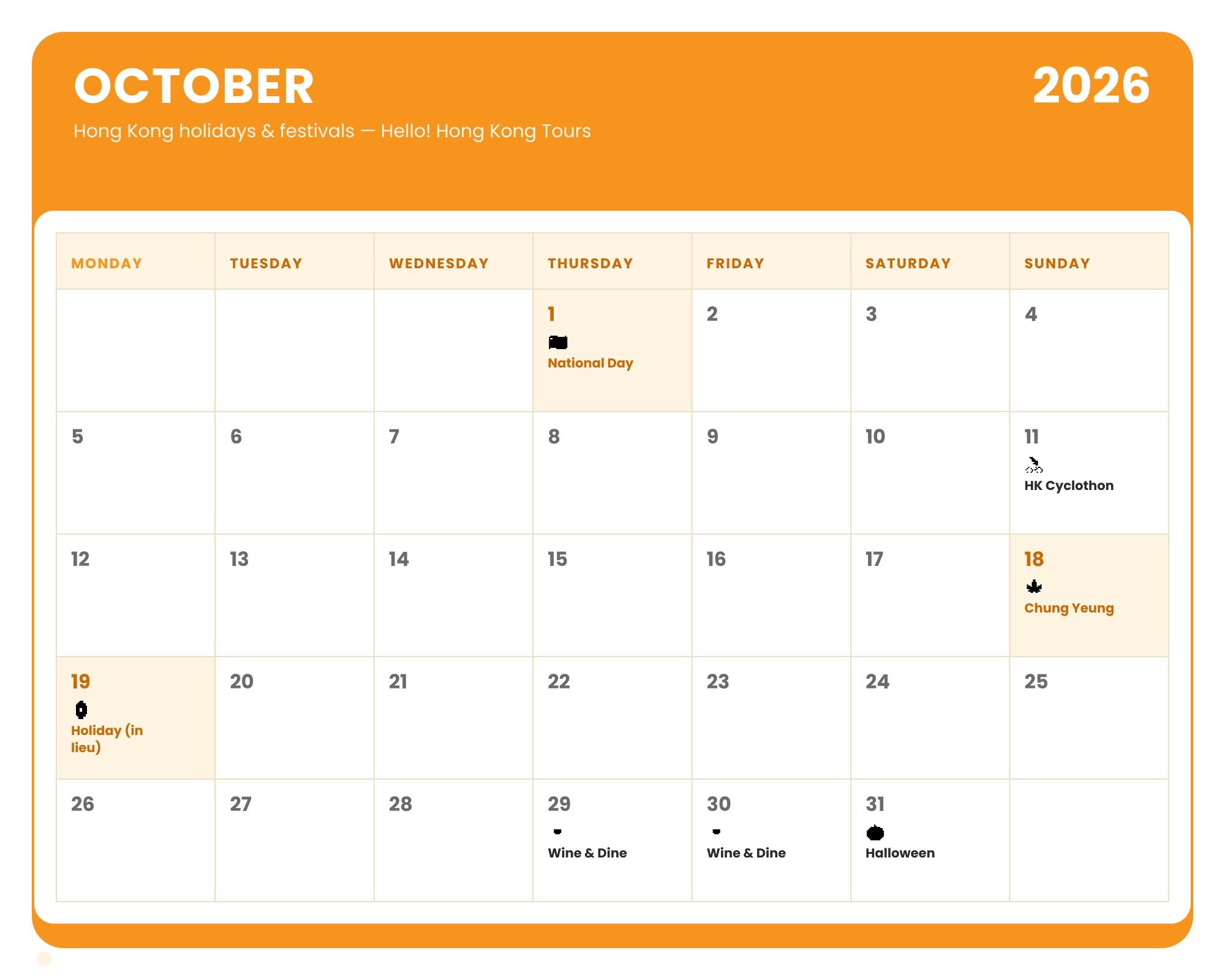
Hong Kong Holidays & Festivals — October 2026

October is one of Hong Kong's best travel months. The summer humidity fades, skies stay mostly clear, and the city moves straight from Mid-Autumn lanterns into a run of holidays, harbourfront festivals, and Halloween parties. Here's what's on the calendar, and what each date actually means if you're visiting.

What each date means

October 1 — Public Holiday

National Day

National Day marks the founding of the People's Republic of China in 1949, and it's one of Hong Kong's 17 general holidays. Expect a fireworks display over Victoria Harbour in the evening, flag-raising ceremonies in the morning, and noticeably heavier crowds at border checkpoints and major attractions, since it kicks off Mainland China's "Golden Week" travel period.

October 11 — Citywide Event

Hong Kong Cyclothon

Not a public holiday, but worth knowing about if you're getting around by road that day. The Cyclothon closes off sections of Hong Kong Island and Kowloon for the city's largest annual cycling event, taking riders past Victoria Harbour, Central, and other landmark routes not normally open to bikes.

October 18 — Public Holiday

Chung Yeung Festival

Also called the Double Ninth Festival, Chung Yeung falls on the ninth day of the ninth lunar month. Traditionally, families climb hills or mountains, visit and tend to ancestral graves, and eat chongyang cake. Because it lands on a Sunday in 2026, the following Monday (October 19) is observed as a substituted public holiday, so expect hiking trails like Victoria Peak and Lion Rock to be busier than usual on both days.

October 29 – November 1 — Festival

Hong Kong Wine & Dine Festival

The Central Harbourfront turns into an open-air food and wine event, with booths from local restaurants, Michelin-starred kitchens, and wineries from around the world, plus live music against the Victoria Harbour skyline. It's the opening act for "Wine & Dine Month," which continues through November with special menus at restaurants and bars across the city.

October 31 — Festival

Halloween in Hong Kong

Halloween isn't a traditional Hong Kong holiday, but the city has adopted it enthusiastically. Lan Kwai Fong fills with costumed crowds, Ocean Park and Disneyland run seasonal haunted attractions through the month, and 2026 brings Hong Kong's first citywide Halloween celebration, spreading the festivities beyond the usual nightlife districts.

Make the most of your October visit

With National Day crowds, Chung Yeung hikers, and Wine & Dine festival-goers all sharing the city this month, a bit of local know-how goes a long way. A private tour with one of our Hong Kong guides means you can time the big sights around the busy dates above, skip the parts of the city that get overrun, and still catch the festival energy where it's worth catching. And if a few hours isn't enough, our guides are happy to help you build out a longer itinerary, whether that's a food crawl through a neighbourhood you haven't tried yet, a day trip to one of the outlying islands, or simply more time exploring at your own pace.

Local Gifts to Bring Home for First‑Time Visitors to Hong Kong

Hong Kong is a captivating blend of traditional Cantonese heritage and global modernity, renowned for its iconic skyline, vibrant street culture, and world‑class dining scenes. For first‑time visitors, traveling is not only about sightseeing but also about bringing authentic local treasures back home. A carefully selected souvenir serves as a heartfelt memento, preserving unique Hong Kong vibes and sharing wonderful travel experiences with family and friends overseas.

Most travelers arrange cultural exploration and local shopping during their Hong Kong trip. Many tourists join a Hong Kong food tour to wander hidden alleyways, taste authentic street food, and immerse themselves in local culinary culture. After exploring the city’s diverse food scenes, picking out exquisite local gifts becomes the perfect finishing touch to a complete Hong Kong travel journey.

Diverse Local Souvenirs Worth Taking Home

Hong Kong boasts an incredibly rich variety of signature souvenirs, covering classic pastries, premium seafood specialties, traditional tea products, and cultural creative gifts, catering to all tastes and gifting scenarios.

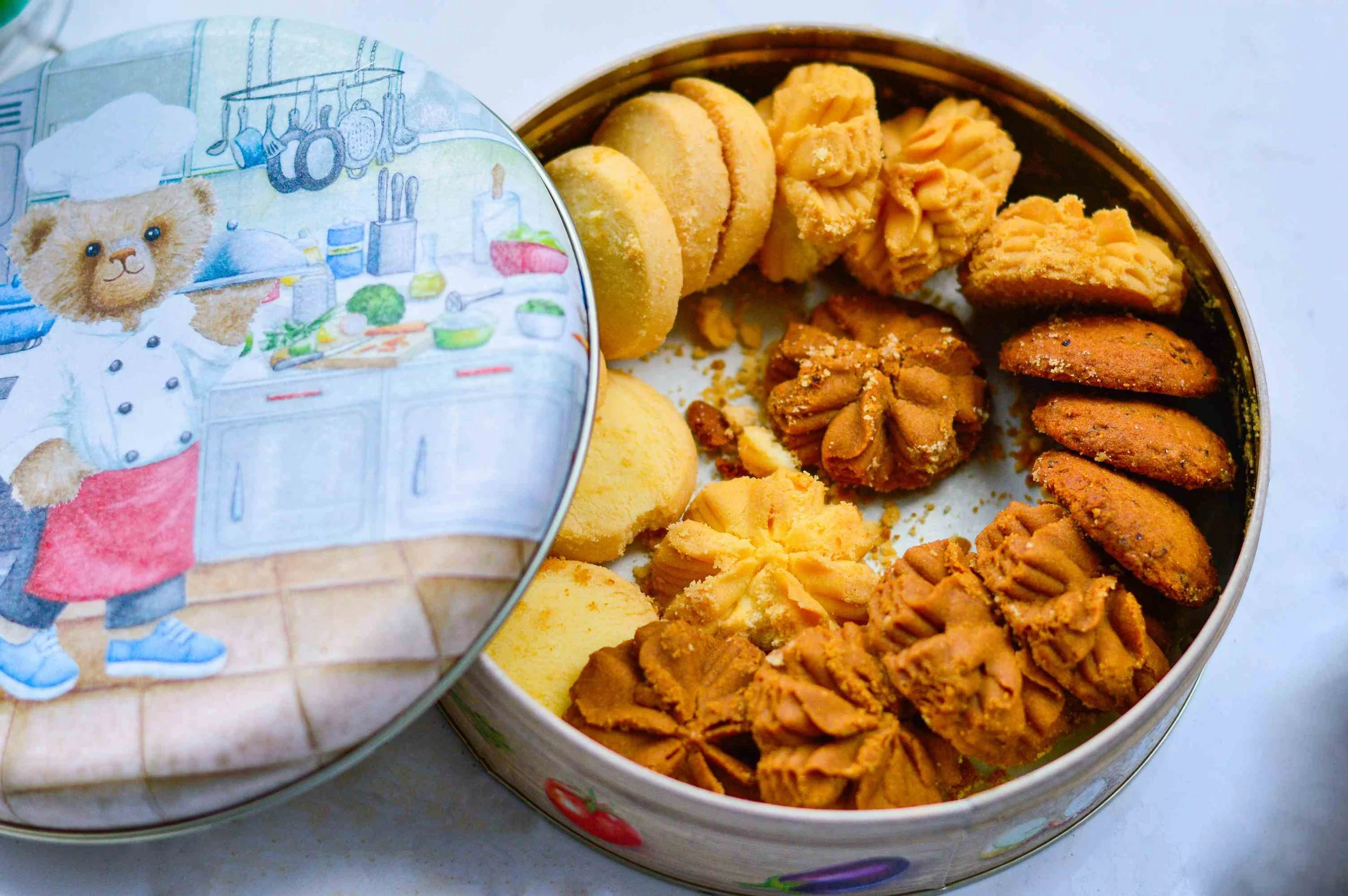
- Classic Butter Cookies & Pastries:Jenny Bakery is iconic for its melt‑in‑mouth butter cookies packaged in collectible bear‑shaped metal tins, a top tourist favorite worldwide. Quartet Cookies is famous for crispy, layered butterfly pastries with a light, sweet flavor, ideal as casual snacks and portable gifts. Traditional bakeries also offer crispy egg rolls, soft wife cakes, and seasonal mooncakes that represent authentic Cantonese baking culture.

- Time‑Honored Cantonese Desserts: Kee Wah Bakery, a century‑old Hong Kong brand, delivers classic local flavors with its handcrafted pastries and festive gift sets. Old‑school confectioneries also sell traditional coconut candy, crunchy sesame sweets, and preserved fruits, carrying the nostalgic taste of old Hong Kong.

- Premium Dried Seafood: As a historic fishing and trading port, Hong Kong is famous for high‑quality dried seafood, including dried scallops, abalones, and fish maw. These premium specialties are classic upscale gifts, embodying Hong Kong’s long‑standing maritime trade culture.

- Local Tea & Drinks Specialties: Hong Kong‑style milk tea leaves, aged Chinese tea, and local herbal tea packs are subtle and elegant gifts. They reflect the daily tea‑drinking lifestyle deeply rooted in local people’s lives.

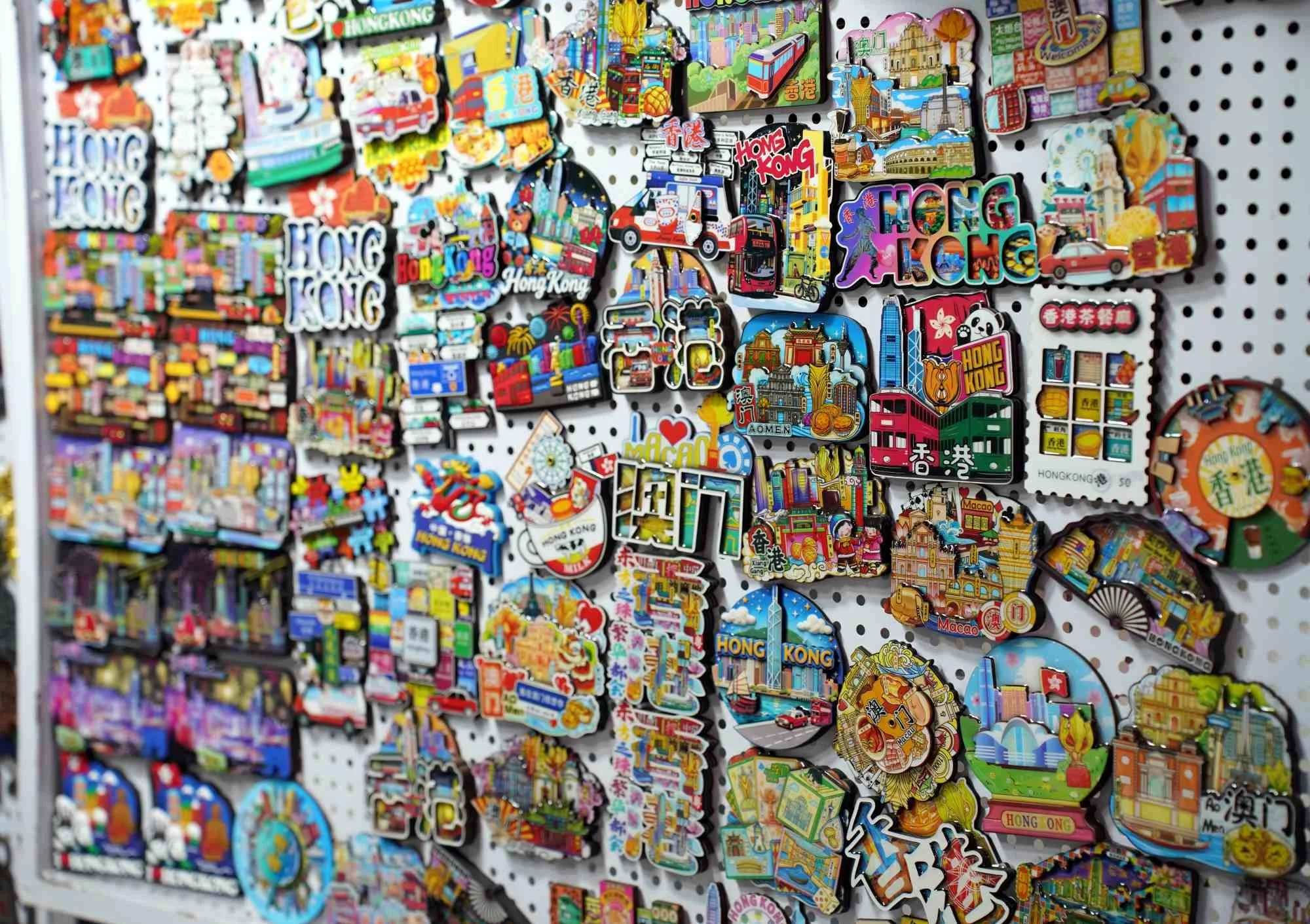
- Hong Kong Cultural Creative Gifts: For travelers who prefer non‑edible souvenirs, Hong Kong‑themed fridge magnets, vintage postcards, classic tram and bus model ornaments, and retro neon‑style crafts are perfect choices. These small items capture the city’s unique East‑meets‑West aesthetic and urban characteristics.

With such a wide range of scattered specialties, a well‑curated Gift Hamper is a very practical choice. It brings together multiple classic Hong Kong specialties in one elegant package, suitable for overseas shipping for many gifting occasions.

Best Neighborhoods to Buy Authentic Hong Kong Souvenirs (With Local Vibes)

The charm of Hong Kong souvenir shopping lies in exploring local old neighborhoods, where every street carries profound cultural heritage and authentic civilian lifestyles. Different districts feature unique shopping styles and local customs, allowing travelers to experience real Hong Kong while hunting for gifts.

Central – Trendy & Iconic Tourist Shopping Hub

Central is Hong Kong’s core business and tourist district, blending modern prosperity and colonial‑style old streets. It is the main outlet for Jenny Bakery, where tourists often line up for fresh, freshly baked signature cookies. Surrounding streets are lined with specialty tea shops, boutique food stores, and cultural souvenir shops selling Hong Kong‑themed creative ornaments. Shopping here combines convenient transportation, standard product quality, and classic Hong Kong urban scenery, perfect for first‑time visitors who prioritize efficiency and authenticity.

Sai Ying Pun & Sheung Wan – Century‑Old Seafood & Traditional Street Culture

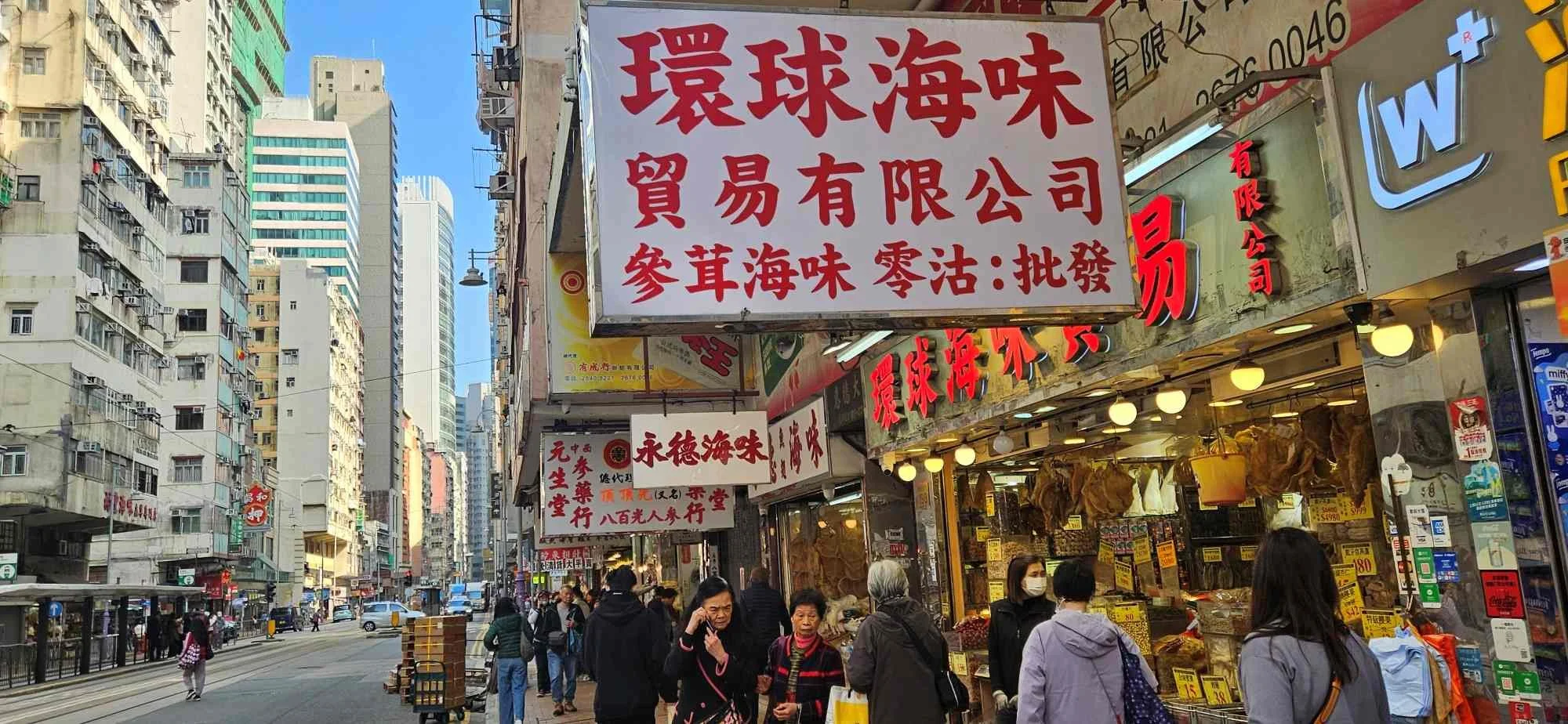
Des Voeux Road West in Sai Ying Pun is Hong Kong’s famous century‑old dried seafood street, gathering generations of local family‑run merchants. Walking along this street, you can smell the natural aroma of dried seafood and feel the slow‑paced old Hong Kong trading customs. Shops here offer high‑quality dried scallops, abalones, and fish maw at transparent prices, favored by locals for daily purchases and gifting. Adjacent Sheung Wan features old herbal tea shops and traditional candy stores, retaining the classic streetscape of early Hong Kong and presenting pure local folk customs.

Sham Shui Po & Mong Kok – Folk Market with Strong Local Vibes

Sham Shui Po and Mong Kok are the most down‑to‑earth old districts in Kowloon, full of strong civilian vibes and local life atmosphere. These areas are home to numerous family‑run old bakeries, retro grocery stores, and street stalls. Unlike high‑end malls, shops here focus on affordable, authentic daily specialties, including traditional pastries, handmade candies, and local snacks. The bustling streets, crowded pedestrians, and old shop signboards fully showcase the lively grassroots culture of Hong Kong. Mong Kok’s Ladies’ Market is also a great spot for affordable cultural souvenirs and small accessories, where bargaining is a local tradition and a unique travel experience.

Wan Chai – Blended Lifestyle of Locals & Tourists

Wan Chai perfectly mixes local residential life and tourist business. Wan Chai Market gathers various local specialty stalls, selling fresh dim sum, dried herbs, and handmade snacks. The nearby mini flower market and retro street stalls add unique local charm. Here, travelers can witness the daily shopping habits of Hong Kong residents and buy down‑to‑earth, uncommercialized local gifts.

City Malls – Convenient One‑Stop Shopping for Tourists

For travelers staying in tourist areas with limited time, major shopping malls including Times Square, Harbour City, and Langham Place have chain branches of Kee Wah Bakery and Quartet Cookies. With centralized store distribution and stable product quality, malls offer a hassle‑free shopping experience, ideal for quick souvenir purchases before departure.

Online Shopping – Zero‑Burden Gifting for Overseas Travelers

In fast‑paced Hong Kong, online gift ordering has become part of people’s everyday life. Trying local online gift shopping can be a worthwhile experience for visitors. Carrying bulky gift boxes while traveling is always inconvenient for overseas visitors. Give Gift Boutique is a well‑loved local gift shop popular among Hong Kong residents for birthday, festive and other gifting occasions. For travellers, it offers professionally curated, ready‑made gift hampers filled with authentic Hong Kong gourmet specialties. Visitors also get to experience Hong Kong’s efficient local delivery services. Orders can even be delivered to your hotel as fast as the same day. Flexible delivery options include direct hotel delivery within Hong Kong and worldwide shipping to overseas homes, letting visitors shop effortlessly without extra luggage weight.

Hello Hong KongHello! Tours